 Skip-the-line available
 The History of Bouzov Castle and the Teutonic Order
From a 1317 stronghold to a Grand Master’s neo-Gothic fantasy, a 1939 Nazi seizure, and a national monument today.
Bouzov looks medieval, but most of what visitors see dates from a single ambitious rebuild commissioned by the Teutonic Order’s last Grand Masters. Here is the full story, from a 1317 stronghold through the 1939 Nazi seizure to today’s national monument.
Medieval beginnings, 1317–1696
Bouzov’s recorded history begins in 1317, when a fortified stronghold was raised on this ridge above the Haná lowlands to help keep watch over the trade routes threading through Moravia. Its first documented owners were the Bůz of Bludovec family, from whom the settlement and castle both took their name, and control passed to the Lords of Kunštát not long afterwards — the same noble line whose descendant Jiří (George) of Poděbrady rose to become King of Bohemia in 1458, though the precise details of his birthplace remain disputed between Bouzov and the family’s other seat at Poděbrady.
For the next two and a half centuries, Bouzov changed hands repeatedly among Moravian noble families, including the Vildenberk and Haugwitz lines, as castles across the region routinely did through inheritance, marriage and sale. It was, for most of this period, a working fortification rather than a showpiece — defensible, administratively useful, but architecturally unremarkable by the standards later applied to it. A serious fire in 1558 damaged the medieval structure badly, and the castle that emerged from repairs afterwards bore little resemblance to the fantasy that would eventually replace it.
By the late 17th century, Bouzov had become, in effect, just another minor Moravian castle with a long but unglamorous history — exactly the kind of property whose fortunes could change overnight with a single well-resourced buyer. That buyer arrived in 1696.
The Teutonic Order buys Bouzov, 1696
In 1696, the Grand Master of the Teutonic Order, Francis Louis of Palatinate-Neuburg, purchased Bouzov Castle. The Teutonic Order was a Catholic religious-military order founded in the late 12th century during the Crusades, and by the medieval period it had carved out and ruled its own state along the Baltic Sea coast, in what is now northern Poland and the Baltic states — one of the most powerful crusading orders in European history. By the time it acquired Bouzov, the Order’s Baltic state had long since dissolved, but it retained significant landholdings and influence across Central Europe, including in Moravia and Bohemia.
For roughly two centuries after 1696, Bouzov served the Order in a fairly conventional way, as one of a number of estates supporting its administrative and religious activities in the region, without any particular architectural distinction. That changed entirely in the final years of the 19th century, when the castle came under the direction of a Grand Master with both the resources and the ambition to remake it completely.
Understanding this Teutonic Order chapter matters for making sense of the castle today: almost everything a visitor associates with Bouzov — the knights’ hall, the chapel, the armoury, even the fantasy of knightly grandeur the building projects — stems from the Order’s final decades of ownership rather than from any earlier medieval period.
Archduke Eugen’s fairy-tale rebuild
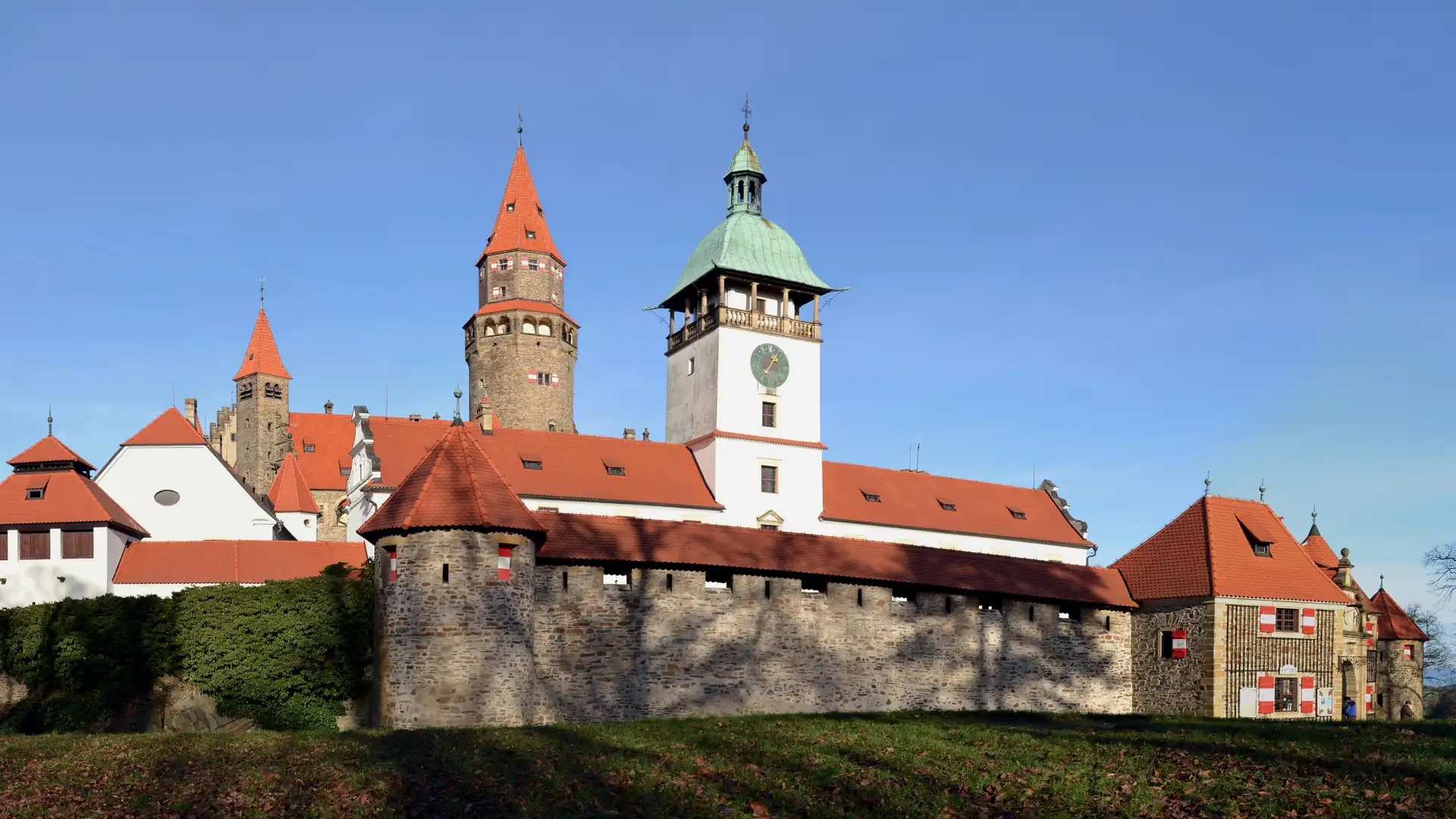
Archduke Eugen of Austria served as Grand Master of the Teutonic Order from 1894 to 1923, and it was under his direction, between 1895 and 1910, that Bouzov was transformed into the castle visitors see today. Eugen was a member of the Habsburg dynasty with both the wealth and the taste for the romantic historicism fashionable among European aristocracy at the turn of the century, and he chose Bouzov as the site for an ambitious personal project: a castle that looked as though it had always been exactly this grand, rather than one that visibly showed its centuries of ordinary, unglamorous use.
The result went far beyond a simple restoration. Entire wings were rebuilt, towers raised or reworked, and interiors created from scratch in a consistent, predominantly neo-Gothic style — the knights’ hall, the chapel with its carved altar, the armoury, and the Grand Master’s own private apartments all date from this single fifteen-year campaign. Modern conveniences were woven in throughout: running water and central heating, discreetly hidden behind walls and detailing designed to look medieval.
It is worth pausing on the scale of the ambition here. Eugen was not patching up an old family seat; he was commissioning, essentially, a brand-new castle built to a 19th-century idea of what a medieval Teutonic stronghold ought to have looked like — a project closer to Bavaria’s Neuschwanstein in spirit than to a conventional heritage restoration.
Georg von Hauberrisser, the architect
The architect behind Bouzov’s transformation was Georg von Hauberrisser (1841–1922), a Munich architect best known internationally for the Neues Rathaus — Munich’s New Town Hall — a similarly grand neo-Gothic civic building completed in stages from the 1860s onward. By the time Archduke Eugen engaged him for Bouzov, Hauberrisser had built a substantial reputation for large-scale historicist architecture, and the commission gave him an unusually free hand: rather than restoring a specific documented medieval appearance, he was asked to design — essentially from imagination — what a castle of legend should look like.
Hauberrisser’s design language at Bouzov draws on the wider Gothic Revival movement sweeping European architecture at the time, visible in the pointed arches, ribbed vaulting, turrets and battlements throughout the castle, but adapted to a residential and ceremonial brief rather than a civic one. The eight-storey, 58-metre tower and the drawbridge over the dry moat are both products of this campaign — dramatic, deliberately theatrical elements added for effect rather than surviving from any genuine medieval defensive need.
Fifteen years is a long commission for a single building, and the consistency of style across that span — from the staircase hall’s ironwork to the chapel’s Gothic altar — is part of what makes Bouzov read as a coherent whole rather than a patchwork of eras, unlike many European castles rebuilt in stages by different hands over centuries.
1939: the Nazi seizure
The Teutonic Order’s long ownership of Bouzov ended abruptly in 1939. Following Nazi Germany’s occupation of the Czech lands, the regime dissolved the Order’s branch in Bohemia and Moravia and confiscated its properties, Bouzov among them. The castle is reported to have passed into the hands of Gestapo chief Heinrich Himmler, who is said to have intended it as a gift for Adolf Hitler — a claim repeated across several sources, though the precise details of the transfer are not as thoroughly documented as the castle’s architectural history, and should be read with that caveat.
Whatever the exact arrangement, Nazi forces occupied Bouzov through the remainder of the Second World War, and the castle was looted during this period, losing furnishings and objects that had accumulated during the Teutonic Order’s tenure. The building itself, however, survived the war structurally intact — unlike many Central European castles that suffered serious damage or destruction between 1939 and 1945.
The 1939 seizure marks the hard break between Bouzov’s life as a private aristocratic and religious-order residence and its later identity as public heritage. Everything that followed — state ownership, museum status, protection as a national monument — flows from this single wartime confiscation.
From state property to national monument
With the liberation of Czechoslovakia in 1945, Bouzov passed into state ownership, where it has remained ever since, administered today by the National Heritage Institute (Národní památkový ústav). The postwar decades saw the castle gradually opened to the public as a museum, its neo-Gothic rooms preserved much as Archduke Eugen and Hauberrisser had left them rather than repurposed for another use, as happened to many former aristocratic properties under state control.
In 1999, Bouzov received formal protection as a national cultural monument, recognition of its significance within Czech heritage that had, by then, already been underlined by decades of public visits and its growing fame as a filming location. Its unmistakable, almost illustrative silhouette made it a natural choice for productions in search of a fairy-tale castle, most notably the Italian television series Fantaghirò in the 1990s and the Czech sequel series Arabela se vrací (Arabela Returns) in 1993.
Today, more than a century after Archduke Eugen’s rebuild concluded, Bouzov functions as exactly what he seems to have intended, even if the audience has changed entirely: a castle built to embody legend, now open for anyone to walk through and judge the fantasy for themselves.
Frequently asked
When was Bouzov Castle first built?
The site was first recorded in 1317, though almost nothing of that original medieval structure survives visibly today — a 1558 fire and the later 1895–1910 rebuild replaced most of it.
Why did the Teutonic Order own a castle in Moravia?
The Order’s Grand Master bought Bouzov in 1696, long after the Order’s medieval Baltic state had dissolved, as one of several Central European estates supporting its ongoing administrative and religious activities.
Who rebuilt Bouzov Castle into its current form?
Archduke Eugen of Austria, Grand Master from 1894 to 1923, commissioned the neo-Gothic rebuild between 1895 and 1910, hiring the Munich architect Georg von Hauberrisser to design it.
Is it true the Nazis seized Bouzov Castle?
Yes. Nazi Germany dissolved the Teutonic Order’s Czech branch in 1939 and confiscated the castle; it is reported, though not exhaustively documented, to have passed to Heinrich Himmler as an intended gift for Hitler.
Who owns Bouzov Castle today?
It has been Czech (formerly Czechoslovak) state property since 1945, administered by the National Heritage Institute, and has held protected status as a national cultural monument since 1999.